
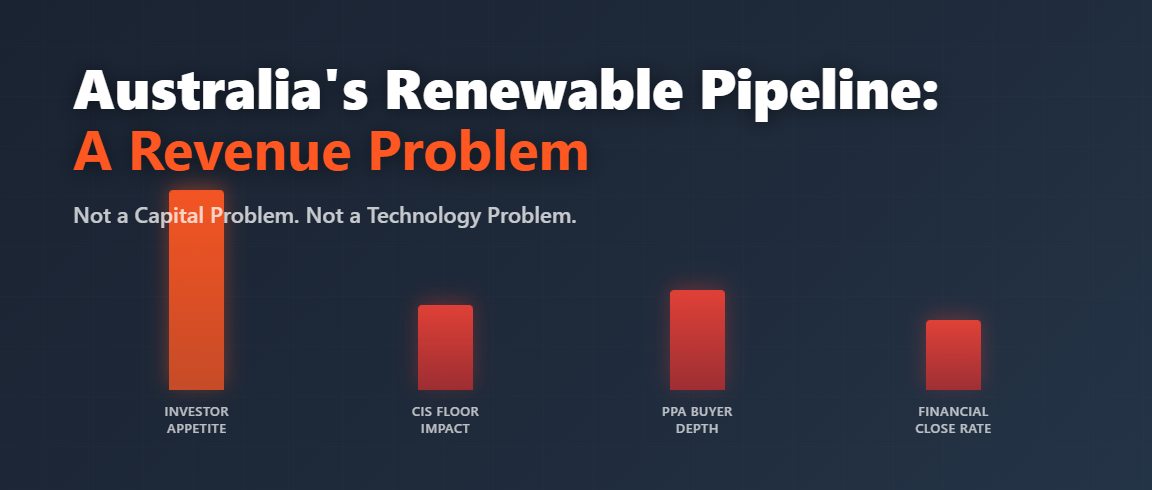
There's something odd happening in Australia's renewable energy sector right now. Investor appetite is through the roof - the Allens Infrastructure Investment Monitor shows 85% of investors planning to deploy capital here over the next three years, with energy transition assets as their primary focus. But fewer projects are actually reaching financial close.
This isn't an EPC capacity issue. It's not about engineering risk. It's not even grid access, though that's certainly part of the conversation. The real constraint is simpler and more fundamental: Australia doesn't generate enough bankable revenue for lenders.
Without bankable revenue, the pipeline can't convert. It doesn't matter how enthusiastic investors are or how ambitious the policy settings look on paper.
The CIS Problem Nobody Wants to Talk About
The Capacity Investment Scheme was supposed to fix this. In practice, it's revealed just how deep the structural issues actually run.
CIS auctions reward the lowest fiscal exposure, not the highest probability of financial close. That design naturally drives revenue floors down. We're seeing floors around $30-40/MWh winning auctions. Those numbers might look competitive in a tender process, but they sit well below the part of the revenue distribution that lenders actually use to size debt.
Here's what lenders care about: P50 and P90 cashflow distributions, adjusted for marginal loss factors, curtailment, congestion, captured price degradation, volatility variance, and inter-regional settlement risk. A revenue floor that sits below your P90 downside case has zero impact on your DSCR calculations. Financially, it's the same as having no floor at all.
This is why CIS hasn't displaced PPAs. It's actually increased dependence on PPAs, because developers still need to source a long-tenor contracted revenue stream that lenders can underwrite. Projects are reaching financial close with CEFC support or bespoke offtake structures, not because of CIS.
Australia's PPA Market Is Structurally Thin
Even if CIS floors were higher, we'd still have a buyer depth problem.
Tier-1 retailers have largely met their RET obligations and pulled back on long-tenor procurement. Tier-2 retailers often lack the credit ratings lenders require. Government-owned corporations have paused or slowed renewable procurement programs. Corporate PPAs are contributing maybe 1-1.5 GW per year. We need something closer to 6 GW per year.
The merchant environment is compressing bankability at the same time. Solar and wind captured prices have fallen sharply as renewable penetration accelerates. Weighted Value of Available Power curves have shifted downward every year from 2018 to 2024. Congestion and constraint risk keep increasing. All of this reduces P90 revenue, which is what debt sizing is anchored to.
Higher merchant risk means higher cost of capital. Higher cost of capital means higher required PPA strike prices. Higher strike prices reduce buyer appetite. Less buyer appetite means more merchant exposure. More merchant exposure raises lender risk again.
CIS was meant to break this cycle. Floors set below lender thresholds can't do that. They don't change the shape of the revenue distribution that determines whether a project is bankable or not.
What Works: Lessons From Markets That Are Actually Delivering
Look at the US, EU, and UK. Renewable deployment accelerates when three things exist together: structural demand for new generation, stable bankable revenue mechanisms, and creditworthy offtakers.
In the US, corporate PPAs expanded because state Renewable Portfolio Standards created mandatory procurement, corporates faced internal decarbonisation pressure, wholesale market volatility made long-term hedges attractive, and the Inflation Reduction Act reduced project cost of capital. US PPAs work as hedging instruments as much as emissions instruments. That dual role increases both buyer participation and lender acceptance.
In the EU, PPA growth accelerated due to ETS exposure that monetises emissions, national renewable and emissions targets, Guarantees of Origin providing accounting integrity, extreme wholesale price swings, and widespread adoption of two-way Contracts for Difference. European CfDs typically clear at €50-70/MWh, well above lender thresholds. They materially reduce downside volatility and raise gearing levels.
In the UK, CfDs have been applied consistently for more than a decade. That stability has created one of the lowest costs of capital for renewables globally. Projects can leverage low-margin debt that remains viable for lenders because the revenue structure actually works.
Here's what's consistent across all these markets: PPAs scale when policy creates structural demand and when revenue stability sits above lender thresholds.
And here's what these markets don't depend on: voluntary carbon markets. VCMs have never driven utility-scale PPA uptake. They're too short-tenor, too volatile, and too weakly correlated with electricity load to support long-dated project finance debt. They might provide incremental upside. They don't provide bankability.
What Australia Actually Needs to Convert Its Pipeline
We don't need new technology to accelerate renewable deployment. We need revenue architecture that aligns with lender requirements.
First, Australia needs a structural buyer. A scalable buyer could take several forms: a central procurement body, mandated procurement obligations over government load, regulated procurement for retailers or large industrials, or a UK-style intermediary like LCCC. Without a structural buyer, supply-side mechanisms can't drive delivery.
Second, we need credit support behind offtakers. Many potential buyers are constrained by credit ratings, not intent. A sovereign or quasi-sovereign credit enhancement facility could expand the pool of bankable offtakers by supporting tier-2 retailers, large industrial buyers, and aggregated SME procurement. Credit support directly increases PPA volume.
Third, CIS floors must be calibrated to lender thresholds. A CIS floor needs to sit within the region of the revenue curve that's relevant to debt sizing. In current market conditions, that implies floors around $60-70/MWh, not $30-40/MWh. Hybrid CfD-PPA structures might also improve deliverability.
Fourth, corporate procurement must be simplified. Australia can expand PPA uptake by standardising VPPA templates, enabling SME load aggregation, and creating predictable certificate rules that reward long-tenor offtake. Reducing transaction friction increases buyer participation.
The Bottom Line
The constraint isn't ambition. It's not capital. It's not technology. The constraint is the quality, stability, and creditworthiness of long-term revenue.
Fix that, and the pipeline converts. Leave it broken, and we'll keep wondering why investor enthusiasm isn't translating into projects on the ground.