

Could the next big clean energy source be hiding right under our feet? Hydrogen has been heralded as a clean fuel for the net-zero transition, but until recently the debate revolved around manufactured hydrogen — namely green (from water electrolysis using renewables) and blue (from natural gas with carbon capture).
A largely overlooked third option is now emerging: geologic hydrogen (also dubbed white or gold hydrogen) that is produced by natural subsurface processes and extracted from the earth. Unlike green and blue, which require significant energy inputs or carbon management, geologic hydrogen is a primary energy source — akin to a "naturally occurring battery" in the ground.
The question is, can this underground hydrogen revolution compete with its green and blue counterparts on cost, scale, and sustainability? Early signs suggest it just might, and energy explorers worldwide are taking notice.
Unlike manufactured hydrogen, geologic hydrogen is created naturally in the Earth's crust. Water interacts with iron- and magnesium-rich rocks deep underground through processes such as serpentinisation (where ultramafic rocks chemically react with water, splitting hydrogen from oxygen) and radiolysis (where natural radiation breaks water molecules apart). The liberated hydrogen migrates upward through fractures until it becomes trapped beneath impermeable layers — sometimes with helium as a companion gas. In essence, the planet itself acts as a slow electrolysis cell, continuously generating and storing hydrogen in geological reservoirs that can, in theory, be tapped like natural gas.

The Cost Question: Why Gold Hydrogen Gleams
One major reason geologic hydrogen is generating buzz is its potential for ultra-low production costs. Today, green hydrogen remains the most expensive form – splitting water with renewable electricity costs roughly $3 to $7+ per kilogram of H₂, depending on region and technology. Blue hydrogen (from methane with CO₂ capture) is cheaper at about $1.5 to $3 per kg, but still relies on fossil gas and carbon storage. By contrast, tapping natural hydrogen deposits could produce hydrogen for as low as $0.5 to $1 per kilogram, essentially an order of magnitude cheaper than green hydrogen. In fact, industry analysts project that if viable reservoirs are found, geologic H₂ could reach about $1/kg, versus roughly $7/kg for renewable-based H₂ and $3/kg for blue hydrogen today1,2,3. A recent techno-economic assessment from Stanford University researchers estimates U.S. production costs well below $1 – on the order of $0.54/kg for natural H₂ and $0.92/kg for stimulated H₂ (where the subsurface is engineered to generate more hydrogen) under optimal conditions10. Such low costs, if realized, would be transformative, making hydrogen affordable without hefty subsidies.
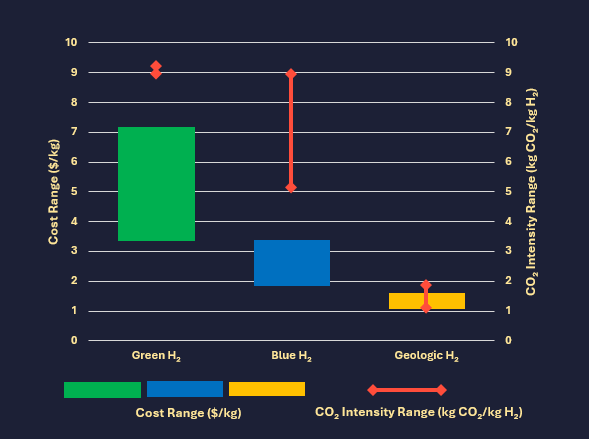
Importantly, geologic hydrogen's advantage isn't just cost – it's also carbon intensity. Because the hydrogen is generated by natural geochemical reactions underground (e.g., water reacting with iron-rich rocks) and often emerges nearly pure, very little CO₂ is emitted in its production. A reservoir gas with ~85% H₂ and minimal methane would have a life-cycle footprint of only ~0.4 kg CO₂e per kg H₂. Even with some methane co-produced (e.g., 75% H₂, 22% CH₄), the intensity might be ~1.5 kg CO₂e/kg – far lower than most blue hydrogen (typically 5–9 kg CO₂e/kg) and well below the U.S. IRA threshold of 4 kg CO₂e/kg for "clean" hydrogen12,4,5. In other words, "white" hydrogen could qualify as truly low-carbon hydrogen and even earn production tax credits for clean H₂. The combination of less than $1 costs and minimal emissions underpins why some have called natural hydrogen a potential golden ticket for the energy transition.
From Mali to Montana: Early Geologic Hydrogen Projects
Geologic hydrogen has moved quickly from scientific curiosity to a nascent boom, with dozens of pilot projects sprouting up. In the 2010s, the idea of drilling for hydrogen gas sounded quixotic – now over 40 companies are actively exploring for "white hydrogen" across at least nine countries. Here are some notable efforts shaping this new frontier:
Mali (Bourakébougou) – The only place in the world currently producing natural hydrogen. This accidental discovery dates back to 1987, when a water well in Bourakébougou struck hydrogen. Since 2012, a small pilot operated by Hydroma (formerly Petroma) has been extracting hydrogen (98% purity) to generate electricity for the local village. Though tiny in scale – on the order of 5 tonnes of H₂ per year – it proved the concept that naturally accumulated hydrogen can be tapped and used. The Mali field, a hydrogen-rich aquifer, even seems to recharge itself, suggesting a steady source7,8.
United States – The U.S. has quietly become a hotbed of natural hydrogen exploration, especially in the Midwest. In 2019, Natural Hydrogen Energy LLC drilled one of the first pure-play H₂ wells in Nebraska (Hoarty NE3) and did encounter hydrogen gas, though the project remains in testing phase. Exploration is now intensifying along the ancient Midcontinent Rift in states like Kansas, Nebraska, and Iowa. Notably, startup Koloma has raised over $300 million (with backing from Bill Gates's Breakthrough Energy) to drill for hydrogen in Kansas – a state already known for helium-rich gas production. In 2023, HyTerra and partners announced a significant dual find of hydrogen (~83%) and helium (~5%) in a Kansas well, marking one of the first confirmed modern H₂ discoveries in North America. With major investors and even oil-patch veterans jumping in, the U.S. could see its first pilot production well within a few years13,14,15.
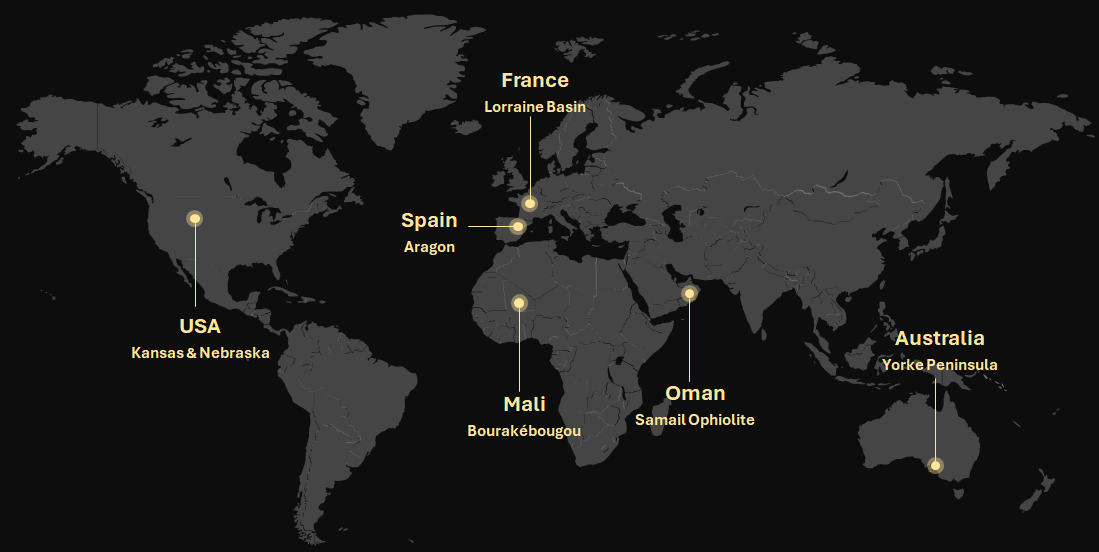
Australia – Australia's ancient geology makes it prime hunting ground for natural hydrogen. In South Australia, the state government formally added hydrogen to its list of regulated resources in 2021, spurring a land rush for exploration licenses. One company, Gold Hydrogen, secured a 5-year license covering the Ramsay project (Yorke Peninsula) and struck hydrogen concentrations up to ~86% in test wells in late 2023. That success has fast-tracked plans for a pilot production test and feasibility study in 2024. Dozens of other Australian prospects are in early exploration, supported by federal research funding. A recent government-sponsored survey found elevated hydrogen seepage in multiple regions along with helium – reinforcing the view that Australia may host substantial natural H₂ resources18,19.
France & Europe – Europe awoke to geologic hydrogen when a surprise find was made in northeast France. In 2023, researchers drilling in Lorraine for natural gas instead discovered what could be the largest natural hydrogen deposit ever found – estimated at up to 250 million tonnes of H₂ in place. The hydrogen, generated by groundwater reacting with iron-rich rocks, may even be actively replenishing itself. This blockbuster discovery, enough to meet global H₂ demand for ~2 years if fully tapped, has galvanized European interest. The French government has already granted two new exploration permits in 2025 (the "Grand Rieu" and "Marensin" licenses covering ~950 km² in the Landes and Pyrénées-Atlantiques regions) to joint venture partners 45-8 Energy and Storengy. Other countries are following suit: Spain's startup Helios Aragón (headed by former oil & gas veterans) is drilling in search of commercial hydrogen and aims for Europe's first natural H₂ production by 2029. Exploration campaigns or studies are also underway in the UK, Germany, Norway, and even smaller nations like Albania and Colombia as part of this hydrogen "gold rush"16,17,20.
It's worth noting that despite the flurry of drilling, Bourakébougou in Mali remains the only site producing hydrogen at scale so far. All other projects are in exploratory or pilot stages. Within the next few years, however, we'll know if these are dry holes or the start of a new energy bonanza. As one geologist quipped, "we've drilled a lot of dry holes" in our time – but if even 1 in 10 hydrogen wells hits, it could rewrite the hydrogen cost curve.
Navigating Uncharted Territory: Regulation and Policy
A significant hurdle for geologic hydrogen's development is the lack of clear regulatory frameworks – in essence, how do we legally classify and govern a new resource that isn't quite a hydrocarbon, mineral, or groundwater? Currently, most countries are playing catch-up. No explicit laws exist in many jurisdictions for natural hydrogen exploration and production. In the UK, for example, hydrogen gas is not specifically addressed by name – any found underground is implicitly covered under the Gas Act 1986, effectively treating it like natural gas by default. Similarly, across the EU, early hydrogen projects must squeeze into old mining or oil/gas laws as an afterthought21.
There are a few bright spots. South Australia has been a trailblazer – in 2021 it amended regulations to include native hydrogen, and within a year roughly one-third of the state was covered by hydrogen exploration permits granted to companies. This early legislative clarity (treating H₂ similar to petroleum for licensing) gave Australia's explorers a head-start19. France also moved quickly after its big discovery: authorities created dedicated natural hydrogen licenses, awarding the first two in early 2025 as noted above. These licenses run for five years and require environmental oversight but signal to investors that France is open for H₂ business17.
In the United States, there isn't a federal hydrogen exploration law yet, but policy support is growing through funding and incentives. The Department of Energy launched R&D programs (like the $20 million ARPA-E initiative on subsurface hydrogen in 2024) to study how to safely stimulate and extract hydrogen from rocks. The U.S. also included hydrogen in its 2022 Inflation Reduction Act: importantly, all forms of low-carbon hydrogen can earn up to $3/kg in production tax credits, which means a successful natural hydrogen well with ~0.4 kg CO₂e/kg could qualify for the full credit. This effectively pays producers to deliver clean H₂ and could make a geologic project extremely lucrative. Government agencies like the USGS are now mapping hydrogen prospectivity (the first national hydrogen resource map was released in 2025), and a U.S. Senate committee held hearings on geologic hydrogen to examine needed regulatory steps. The sense in Washington is that if natural hydrogen shows promise, lawmakers will craft a new category for it – neither a "mineral" (since it's a gas) nor a "hydrocarbon" (no carbon in H₂), but as a unique renewable subsurface resource. Getting these rules right will be crucial to scaling up: clear tenure, safety standards, and royalty regimes can either unlock investment or hold it back. As of now, the legal landscape is evolving rapidly, with pioneers and policymakers collaboratively feeling out the "rules of the game" for this new resource11,12.

Helium: The Invisible Sidekick
Interestingly, Mother Nature seldom serves up pure hydrogen on its own – and that's not a bad thing. Many natural hydrogen occurrences contain a mix of gases, often including helium, nitrogen, and light hydrocarbons. In particular, helium has emerged as a valuable co-product that could sweeten the economics of H₂ wells. Helium is a critical gas (used in MRI machines, semiconductors, rocketry and more) that is rare, non-renewable, and in short supply globally. Even a small percentage of helium in a hydrogen stream can be commercially attractive because of helium's high price22,23. In the U.S., companies historically needed around 0.3% He in natural gas for it to be worth separating – a threshold now often met or exceeded in known hydrogen-prone areas. For instance, the recent Kansas tests found up to 5% helium alongside hydrogen, a remarkably high concentration that would be highly profitable to extract. Many other H₂ prospects report helium in the 0.1% to 1% range, which could provide a nice revenue bonus on top of hydrogen sales15.
From a technical standpoint, co-producing helium simply means adding gas separation steps that are well-known in the industrial gas industry (cooling and pressure swing adsorption, for example, to isolate helium which is even lighter and unreactive). The synergy is that a single well and processing facility can deliver two products: clean energy (H₂) and a critical industrial gas (He). According to geoscientists, hydrogen and helium often originate together in basement rocks via radiolysis – radioactive decay splits water to H₂ and also generates helium by alpha particle decay of uranium/thorium. They can migrate up and become trapped in the same reservoirs. Exploration firms like Getech note that integrating helium into natural hydrogen exploration greatly boosts economic viability, and they now use co-location strategies to pinpoint prospects rich in both gases. In effect, helium can act as a financial buffer: even if a hydrogen play is marginal, a few percent of helium could tip it into profitability. The flip side is also true – helium explorers are now eyeing hydrogen as a bonus prize (a "two-for-one" discovery). This rare combination of H₂ + He is drawing interest from major investors since it diversifies the revenue stream. Going forward, we may see pilot projects designed to produce fuel for the clean economy (H₂) and helium for high-tech industries in tandem, a compelling model for maximizing subsurface assets22.
The Road Ahead: Hype, Hope, and Hard Questions
Geologic hydrogen, once a geological oddity, is fast becoming a serious contender in the clean energy narrative. Its allure is clear: a potentially vast, naturally replenishing source of zero-carbon hydrogen that could be delivered for pennies on the dollar compared to electrolytic hydrogen. The vision is enticing – hydrogen no longer just as an energy carrier (made elsewhere at great expense) but as a primary energy source that we simply extract, much like geothermal or natural gas. If the most optimistic resource estimates prove even partially true, the Earth could hold trillions of tonnes of H₂ underground, enough to fundamentally shift the trajectory of the hydrogen economy and, by extension, the energy transition.
That said, major questions loom. Can we find geologic hydrogen in volumes that are commercially significant? Thus far, only modest flows have been demonstrated. The exploration success rate and typical field sizes remain unknown – it's possible many identified "leads" will turn out to be small pockets or seeps that can't sustain long-term production. How do we safely produce and handle hydrogen from the ground? The oil & gas industry provides a template (drilling rigs, well completions, surface processing), but hydrogen's properties differ from methane and there's little real-world experience managing a hydrogen field. Issues like subsurface microbiology (hydrogen can be consumed by microbes) and embrittlement of well materials will need careful study. Will local communities accept drilling for hydrogen? In some regions, there is public resistance to new drilling of any kind, and operators will need to prove that hydrogen wells won't cause leaks, quakes or other issues associated with fossil fuel extraction. And crucially, how "renewable" is natural hydrogen? Some geologists hypothesize these systems could recharge (like Mali's seemingly has) as water and rock continue reacting, but the replenishment rate might be too slow to count on for human timescales if production is too aggressive.
The next few years will be pivotal. Pilot projects across Mali, the U.S., Australia, France, and elsewhere will tell us a lot about flow rates, reservoir sizes, and the practical realities of bringing white hydrogen to market. Engineers and policymakers will concurrently be building the plane as they fly it – crafting new regulations, technologies, and business models around this resource. It's a classic frontier scenario: high uncertainty, but also high potential reward. As one energy executive remarked, natural hydrogen could cause the biggest disruption to the global energy system in decades – if it works. Main Character Energy will be watching closely as the subsurface switch is flipped in real time, potentially lighting a new path toward affordable, clean hydrogen. The hydrogen rainbow may soon have a shining new color, pulled from deep below the ground, to power our green future.
References
- IEA (2023) Global Hydrogen Review 2023.
- IRENA (2022) Green Hydrogen Cost Reduction.
- IEA (2021) The Future of Hydrogen.
- Howarth & Jacobson (2021) "Blue Hydrogen: Bridge or Dead End?" Energy Science & Engineering.
- Zgonnik V. (2020) The Occurrence and Geoscience of Natural Hydrogen. Earth-Science Reviews, 203.
- Sherwood Lollar B. et al. (2022) Natural hydrogen in the Earth's subsurface. PNAS.
- Hydroma Inc. (2021) Bourakébougou Project Data.
- CNRS (2022) Hydrogen-Producing Aquifers in Mali.
- Smith & Tassy (2023) Global Natural Hydrogen Resource Assessment. Nature Geoscience.
- Kammer R. et al. (2023) Techno-Economic Assessment of Natural Hydrogen Production. Stanford University.
- U.S. DOE (2024) ARPA-E Subsurface Hydrogen Program Overview.
- U.S. DOE (2023) Clean Hydrogen Production Standard – Life-Cycle Analysis.
- Natural Hydrogen Energy LLC (2019) Project NE-3 Drilling Summary.
- Koloma Inc. (2024) Investor Brief.
- HyTerra Ltd (2024) Kansas Well Testing Report.
- CNRS / Université de Lorraine (2023) Discovery of Deep Hydrogen in France.
- French Ministry of Ecological Transition (2025) Natural Hydrogen Licensing Decrees.
- Gold Hydrogen Ltd (2023) ASX Announcement – Ramsay Project Drilling Results.
- Government of South Australia (2024) Hydrogen and Geothermal Resources Report.
- Helios Aragón SL (2024) Corporate Presentation.
- UK Department for Energy Security (2024) Hydrogen Policy and Regulatory Review.
- Ballentine & Sherwood Lollar (2020) Helium and Hydrogen Co-generation Mechanisms. Geochemistry Geophysics Geosystems.
- U.S. Bureau of Land Management (2022) Helium Resource Assessment Update